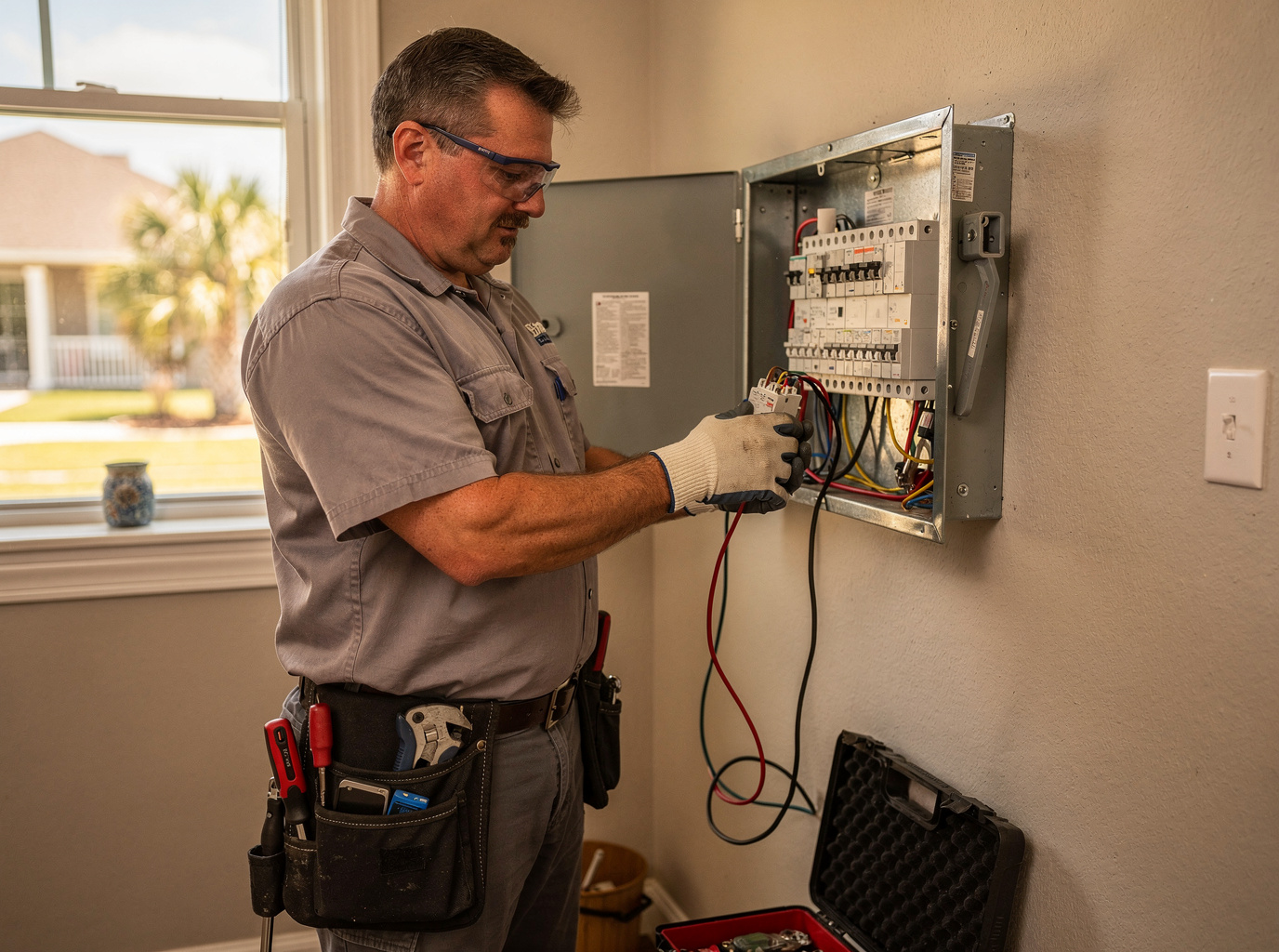
Homes built in the 1970s and 1980s around Bluewater Bay and Valparaiso often carry Federal Pacific or Zinsco panels that overheat under the constant humidity of Okaloosa County. Replacement starts with identifying the exact panel type before any work begins, because mismatched breakers create fire hazards in the mild winters when residents run space heaters alongside air conditioning. Local electricians check for corrosion on bus bars caused by moisture drifting in from Boggy Bayou before swapping components.
Code updates in Florida require arc-fault protection in most living areas, so a simple breaker swap frequently turns into a partial panel upgrade when inspectors visit properties near Niceville Community Park. Technicians carry both single-pole and double-pole AFCI breakers on the truck because many older homes lack the neutral pigtails needed for the new devices. Skipping this step leaves homeowners exposed during the humid summer when lightning strikes are common across the county.
Service calls in Fort Walton Beach and Destin spillover areas show that water intrusion from roof leaks or high water tables near the bayou accelerates breaker failure. Replacement includes torque testing every connection to manufacturer specs and labeling the new panel directory so residents know which circuits serve their waterfront properties. This prevents repeated trips when a breaker trips during peak tourist season loads.
Technician insight
In Niceville the humidity drifting off Boggy Bayou corrodes breaker panels faster than most homeowners expect, especially in 1970s homes around Bluewater Bay where original Federal Pacific stabs have already loosened.
Overloaded panel in Bluewater Bay
A homeowner near Niceville Community Park kept resetting a tripped 20-amp breaker serving the living room. Inspection revealed corrosion on the bus bar from bayou moisture and an undersized breaker for modern electronics. The old breaker was replaced with an AFCI unit, connections were cleaned and torqued, and the panel directory was updated so the family could track loads during humid summer months.
Circuit Breaker Replacement Services We Offer
✓Single Pole Breaker Replacement
Swaps failed 15- or 20-amp breakers in kitchens and bedrooms common to Bluewater Bay ranch homes.
✓Double Pole Breaker Replacement
Replaces 30- to 60-amp breakers serving air conditioners and dryers in Valparaiso properties.
✓AFCI Breaker Upgrade
Installs arc-fault breakers required by current Okaloosa County code in living spaces.
✓GFCI Breaker Installation
Adds ground-fault protection for outdoor circuits near Boggy Bayou and pool areas.
✓Panel Bus Bar Inspection
Checks for corrosion before replacement in homes exposed to subtropical humidity.
✓Whole Panel Replacement
Removes outdated Federal Pacific panels found in many 1970s Niceville neighborhoods.
Circuit Breaker Replacement Cost in Niceville, FL
| Service | Typical Range | What Affects It |
|---|---|---|
| Single pole breaker swap | $150–$300 | Common in Bluewater Bay homes; price rises with corrosion cleanup. |
| Double pole breaker swap | $250–$450 | Larger loads like AC units near Valparaiso increase time. |
| AFCI breaker install | $200–$400 | Required in living areas; neutral pigtail work adds cost. |
| Full panel replacement | $1,200–$2,800 | Older Federal Pacific panels in Okaloosa County homes. |
Ranges are typical for Niceville, FL and confirmed with an exact written quote before any work starts.
How it works
- 1
Initial Assessment
Technician inspects the panel, notes corrosion from local humidity, and confirms breaker type.
- 2
Power Isolation
Main breaker is shut off and verified dead with a meter before any work starts.
- 3
Old Breaker Removal
Wires are labeled, old breaker is extracted, and bus bar is cleaned of oxidation.
- 4
New Breaker Installation
Correct amperage and type breaker is seated, torqued, and connected per code.
- 5
Testing and Labeling
Circuits are restored one by one, tested under load, and the directory is updated.
Pricing
Most circuit breaker jobs in Niceville fall between $150 and $650 depending on panel condition and breaker type.